


A Garden Hose Connector that leaks after one summer is rarely a simple design flaw—it is usually the result of poor molding control, weak material selection, or inadequate pressure testing. In competitive garden tool manufacturing, small details such as±0.02 mm molding tolerances, UV-stabilized plastics, mold steel selection, and airtightness checks determine whether a sprinkler, nozzle, or Hose Fitting performs reliably outdoors. This article looks inside the production and testing workflow behind durable watering accessories, from automated injection molding and material engineering to quality control protocols that simulate real household water pressure and beyond. For buyers, engineers, and sourcing teams, these benchmarks help separate commodity suppliers from manufacturers capable of consistent, field-ready production.
Precision Injection Molding for Garden Tools
The foundation of a reliable garden tool manufacturer lies in the precision of its injection molding facility. Producing durable hose connectors, sprinkler bases, and spray nozzles requires strict dimensional accuracy to ensure seamless integration with standard plumbing fixtures and long-lasting performance in consumer gardens.
Modern facilities utilize advanced automated injection molding machines that maintain molding tolerances within ±0.02 mm. This exactness is critical for avoiding micro-gaps at connection points, which could otherwise lead to severe leaks under high water pressure. Advanced temperature control systems regulate the molten plastic flow, preventing warping and ensuring structural integrity across high-volume production runs. To support continuous manufacturing, industrial molds are frequently machined from hardened P20 or H13 steel, guaranteeing a tooling lifespan of up to 500,000 injection shots before requiring maintenance.
UV-Resistant Raw Materials
Garden tools are subjected to continuous outdoor exposure, making material selection a critical engineering decision. High-grade Acrylonitrile Butadiene Styrene (ABS), Polypropylene (PP), and Thermoplastic Rubber (TPR) are routinely enhanced with specialized UV inhibitors before the molding process begins to prevent structural breakdown.
Without these chemical additives, raw plastics quickly become brittle and discolored under direct sunlight. Premium manufacturing protocols require materials to achieve a UV resistance rating of at least Grade 4 under ISO 105-A02 standards. This specification guarantees a minimum outdoor lifespan of three to five years without significant degradation, cracking, or cosmetic fading, even in harsh summer climates.
Key Manufacturing Terms
Navigating the production process requires familiarity with several core injection molding concepts. "Cavity" refers to the hollow space in the mold; a 16-cavity mold, for instance, produces 16 individual parts per cycle, directly impacting unit cost and daily output. "Clamping Force" indicates the pressure holding the mold closed, typically ranging from 150 to 300 tons for standard watering accessories. "Cycle Time" is the total duration required to mold one batch of parts, which averages 25 to 40 seconds depending on component complexity.
| Material | Primary Application | Tensile Strength | UV Resistance Profile |
|---|---|---|---|
| ABS | Sprinkler bodies, rigid connectors | 40 - 50 MPa | High (with standard inhibitors) |
| PP | Hose reels, structural bases | 30 - 40 MPa | Moderate (requires specialized additives) |
| TPR | Ergonomic grips, nozzle handles | 5 - 15 MPa | Excellent flexibility under UV exposure |
Water-Pressure Testing and Quality Control
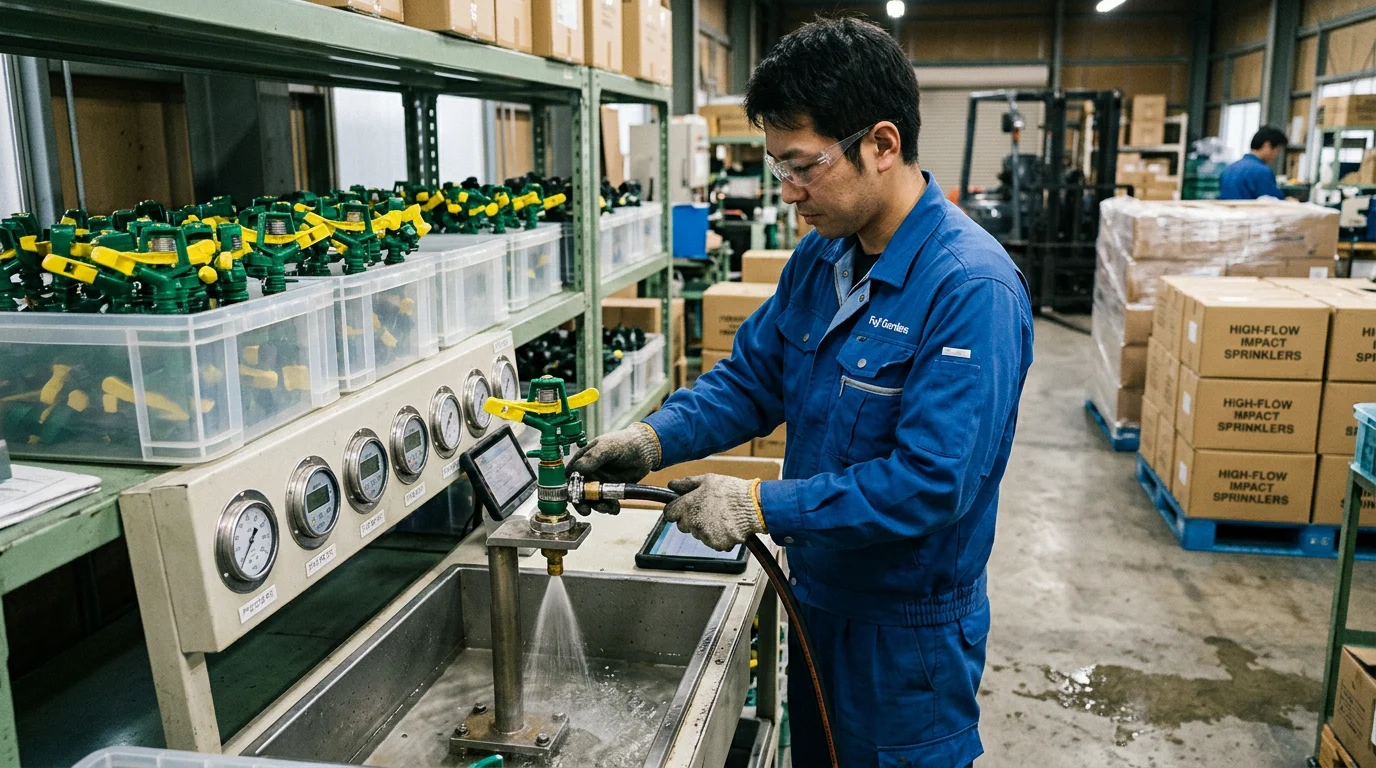
Even with precise injection molding, robust quality control protocols are necessary to guarantee that every watering tool performs reliably in the field. A reputable garden tool manufacturer integrates rigorous testing at multiple stages of the assembly line to catch structural flaws before products are boxed.
While standard residential water systems operate between 40 and 60 PSI, professional-grade garden tools must be engineered to withstand significantly higher thresholds. Quality assurance teams employ both automated inline testing and destructive batch sampling to verify that structural limits, O-rings, and sealing mechanisms exceed everyday usage demands.
100% Airtightness Testing
To verify the integrity of internal seals without introducing moisture that could foster bacterial growth during transit, facilities utilize pneumatic airtightness testing. Instead of water, compressed air is forced into the assembled nozzles, wands, and quick-connectors to simulate fluid dynamics.
During this automated procedure, components are pressurized to 120 PSI (8.2 bar) for a duration of 15 seconds. High-sensitivity pneumatic sensors monitor the internal pressure of the tool; a pressure drop exceeding 0.1 PSI immediately flags the unit as defective. This 100% inline testing ensures that no leaking product advances to the final packaging stage.
Pre-Shipment Inspection Steps
Before any batch is cleared for export, a comprehensive pre-shipment inspection is conducted based on the international Acceptable Quality Limit (AQL) framework. Leading manufacturers adhere to an AQL of 1.5 for major defects, such as faulty trigger mechanisms, and 4.0 for minor defects, like slight surface scratches.
This final validation phase includes extreme destructive testing on random samples pulled from the production line. Products undergo burst testing, where they are subjected to extreme water pressures up to 250 PSI to identify the absolute failure point of the plastic housing. Additionally, environmental stress tests, including thermal shock transitions from -10°C to 60°C, and drop tests from a height of 1.2 meters onto concrete surfaces, are performed to verify the impact resistance of the assembled materials.
Reducing OEM/ODM Sourcing Risk
Sourcing OEM and ODM garden tools from overseas presents inherent risks related to product consistency, communication barriers, and supply chain reliability. Partnering with an established manufacturer that manages both tooling and assembly in-house significantly mitigates these common industry vulnerabilities.
Consolidating production under one roof reduces standard lead times to an efficient 35 to 45 days, while allowing for manageable Minimum Order Quantities (MOQs), typically structured around 2,000 units per SKU. This centralized approach affords buyers greater control over product customization, brand alignment, and the protection of proprietary intellectual property through strict non-disclosure agreements.
Pantone Color Matching Process
For global retail brands, maintaining a strict visual identity across all product lines is non-negotiable. Custom garden tools require precise color matching, which is achieved through the meticulous formulation of plastic masterbatches tailored to specific brand guidelines.
Quality control engineers utilize digital spectrophotometers to compare the molded plastic against the client's specified Pantone coordinates. The manufacturing standard demands a Delta E (ΔE) value of less than 2.0, ensuring that any color variation is entirely imperceptible to the human eye. This strict tolerance guarantees absolute batch-to-batch consistency, whether the retail order is placed in the spring or restocked in the fall.
How Overseas Buyers Should Choose a Manufacturer
Selecting the right production partner requires evaluating both technical capabilities and ethical compliance. Buyers should verify that a factory holds active ISO 9001 certifications for quality management and BSCI audits for social responsibility. Furthermore, assessing the ratio of automated machinery to manual labor provides insight into the facility's ability to scale operations efficiently while controlling long-term labor costs.
A capable partner will offer transparent communication, comprehensive Design for Manufacturability (DFM) analysis,
Key Takeaways
- Specify injection molding tolerances near ±0.02 mm for hose connectors and nozzles to reduce leak risks at threaded or sealed connection points.
- Choose ABS, PP, or TPR based on the part function, since rigid bodies, structural bases, and ergonomic grips require different strength and flexibility profiles.
- Require UV inhibitors and at least Grade 4 UV resistance under ISO 105-A02 for garden tools expected to survive three to five years outdoors.
- Use hardened P20 or H13 steel molds for high-volume production because tooling can support up to 500,000 injection shots before maintenance.
- Validate finished watering products against pressures above the typical 40 to 60 PSI residential range using inline inspection and batch testing.
Frequently Asked Questions
1. Why is precision injection molding important for garden tools?
Precision molding keeps hose connectors, sprinkler bases, and nozzles dimensionally accurate, helping parts fit standard plumbing fixtures and preventing micro-gaps that can cause leaks under water pressure.
2. What molding tolerance should a high-quality facility maintain?
Advanced automated injection molding machines can maintain tolerances within ±0.02 mm, which is critical for consistent sealing performance and reliable high-volume production.
3. Which plastics are commonly used in molded garden tools?
Common materials include ABS for sprinkler bodies and rigid connectors, PP for hose reels and structural bases, and TPR for ergonomic grips and nozzle handles.
4. How do manufacturers improve outdoor durability?
Manufacturers add UV inhibitors to plastics before molding. Premium protocols target at least Grade 4 UV resistance under ISO 105-A02 to reduce cracking, fading, and brittleness.
5. How long should UV-resistant garden tool materials last outdoors?
With proper UV additives and material selection, molded garden tool components can maintain performance and appearance for about three to five years in outdoor conditions.