


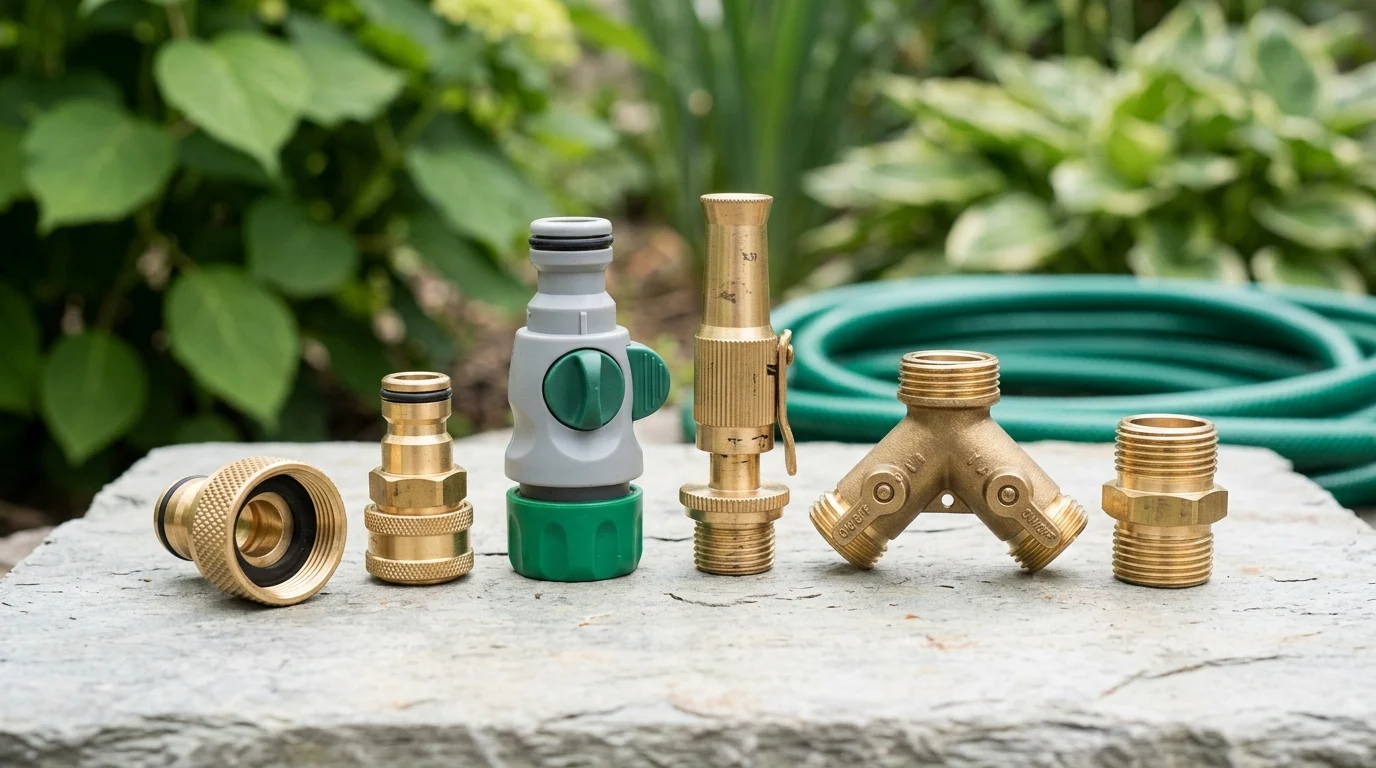
A Garden Hose Fitting may look simple, but a small mismatch in thread geometry can turn an otherwise well-made nozzle, connector, or hose reel into a leaking product complaint. For buyers serving multiple markets, the critical split is betweenGHT, used across the United States and Canada, and BSP standards used throughout much of the rest of the world. The differences are not cosmetic: thread angle, pitch, taper, and sealing method all affect whether a fitting will connect securely. This guide explains how GHT, BSPP, and BSPT differ, why 3/4-inch sizing can be misleading, and what procurement teams should confirm before placing an order.
Garden Hose Thread Basics
Navigating the global supply chain for garden hose fittings requires a strict understanding of regional thread standards. Manufacturers, distributors, and procurement teams must align their product specifications precisely with the destination market to ensure complete compatibility and functionality. The primary division in the watering tools industry lies between North American thread standards and those adopted by the rest of the world.
Selecting the incorrect thread type is one of the most common and costly errors in international sourcing. Understanding the mechanical foundations of these threads is the first step toward building a reliable, leak-free product portfolio.
GHT, BSPP, and BSPT definitions
Garden Hose Thread (GHT), often referred to technically as National Hose (NH) thread, is the undisputed standard across the United States and Canada. It is specifically engineered for residential and commercial watering applications, from basic Lawn Sprinklers to heavy-duty hose reels. Conversely, British Standard Pipe (BSP) dominates the markets in Europe, Asia, Australasia, and parts of Africa.
The BSP standard is further divided into two distinct categories: British Standard Pipe Parallel (BSPP) and British Standard Pipe Tapered (BSPT). While GHT and BSPP are both parallel threads intended for standard hose connections, their distinct geometries make them entirely incompatible. In consumer garden hose contexts within BSP regions, BSPP or proprietary quick-connects are the standard, whereas BSPT is typically reserved for irrigation and industrial pipework. Attempting to mix these standards across different geographic markets will guarantee product failure.
Thread pitch, sealing method, and regional standards
The mechanical differences between these standards are rooted in their thread pitch and thread angle. A common sourcing trap is assuming thread pitches scale identically across regions. GHT utilizes a 60-degree thread angle and is standardized at a precise 11.5 threads per inch (TPI) across 1/2-inch, 5/8-inch, and 3/4-inch hose sizes. Because the threads are cut parallel, GHT cannot form a seal on its own; it relies entirely on a compressible washer—typically made of rubber or silicone—to create a watertight barrier.
BSPP operates on a similar mechanical principle, utilizing parallel threads that require a washer to seal. However, it features a 55-degree thread angle and a pitch of 14 TPI for the ubiquitous 3/4-inch size, and its size-to-thread mapping differs as diameters change. BSPT relies on a tapered design where the male and female threads wedge tightly together. This tapering eliminates the need for a washer, requiring instead thread seal tape or a liquid sealant to prevent leaks.
GHT vs BSP Fitting Differences
Failing to recognize the structural differences between GHT and BSP fittings results in severe leakage and product failure. Procurement teams must understand the physical dimensions and sealing mechanics to prevent market rejections.
Even a millimeter of variance in thread design can render a high-quality brass or plastic nozzle completely useless to the end consumer.
3/4-inch GHT, BSPP, and BSPT comparison
The 3/4-inch fitting is the most ubiquitous size in the consumer watering market, yet its specifications vary drastically by region. A standard 3/4-inch GHT connection has an outer diameter of approximately 1.0625 inches (26.98 mm). In contrast, a 3/4-inch BSP fitting measures roughly 1.041 inches (26.44 mm) in outer diameter.
| Standard | Thread Pitch (TPI) | Thread Angle | Outer Diameter (approx) | Sealing Mechanism | Primary Region |
|---|---|---|---|---|---|
| 3/4" GHT | 11.5 | 60° | 1.0625 in | Washer / O-ring | North America |
| 3/4" BSPP | 14.0 | 55° | 1.0410 in | Washer / O-ring | Europe, Asia, UK |
| 3/4" BSPT | 14.0 | 55° | 1.0410 in | Thread deformation | Global (Irrigation/Industrial) |

This dimensional and geometric variance means that even if the diameters appear visually similar to an untrained eye, the connections are fundamentally incompatible.
Common mismatch risks and leakage causes
The most common mismatch risk occurs when an end-user attempts to thread a GHT male fitting into a BSPP female connector, or vice versa. The difference between 11.5 TPI and 14 TPI guarantees cross-threading after just a single turn. Forcing the connection destroys the brass or plastic threads, leading to immediate blowouts.
Another frequent mismatch involves confusing GHT with National Pipe Thread (NPT). Although both are North American standards featuring a 60-degree angle, NPT is tapered and designed for fixed plumbing, not garden hoses. Fortunately, adapters are widely available to bridge connections between GHT, NPT, and BSPP, which is highly relevant for distributors managing cross-market inventories.
At standard residential water pressures ranging from 60 to 80 PSI, a compromised or cross-threaded fitting will leak profusely. In severe cases, pressure spikes can cause the fitting to detach entirely under load. For distributors, these mismatch errors result in significant reverse logistics costs, negative reviews, and elevated return rates if regional specifications are not strictly managed.
Buyer Specification and Sourcing Checklist
Establishing a reliable supply chain for watering tools demands rigorous specification management. Buyers must implement strict sourcing checklists to ensure overseas manufacturers produce the correct regional threads with consistent, verifiable quality.
A proactive approach to quality control at the factory level eliminates the risk of importing incompatible units.
Drawing, sample, and inspection requirements
Comprehensive technical drawings are the first line of defense against manufacturing errors. CAD files must explicitly call out the thread standard, pitch, and angle, alongside a strict dimensional tolerance of +/- 0.1mm. Before authorizing mass production, buyers should mandate first-article inspections and request physical samples for fit-testing with locally sourced, market-standard hoses.
Quality assurance protocols must also include hydrostatic pressure testing. Buyers should confirm burst ratings with the supplier against their specific market's pressure standards to ensure the seal holds without weepage. Inspections should verify that the thread crests and roots are machined cleanly, without burrs that could damage the sealing washer. To identify threads accurately in the field or during incoming QA, inspectors should use a thread pitch gauge to count TPI, calipers for precise diameter measurement, and visually inspect the sealing surface for washer compatibility.
Material, seal, and supplier selection criteria
Material selection
Key Takeaways
- Specify GHT fittings for the United States and Canada, and verify BSP requirements for Europe, Asia, Australasia, and other global markets.
- Do not interchange GHT and BSPP fittings, because GHT uses a 60-degree thread angle and 11.5 TPI while 3/4-inch BSPP commonly uses a 55-degree angle and 14 TPI.
- Use a rubber or silicone washer for GHT and BSPP hose connections, since parallel threads do not seal by themselves.
- Use thread seal tape or liquid sealant with BSPT connections, because tapered threads seal by wedging together rather than compressing a washer.
- Confirm thread standard, pitch, angle, sealing method, and destination market before sourcing garden hose fittings to avoid leaks, returns, and product rejection.
Frequently Asked Questions
1. What is the main difference between GHT and BSP garden hose threads?
GHT is the North American garden hose standard with a 60-degree thread angle and 11.5 TPI. BSP is used widely outside North America and typically has a 55-degree thread angle, with BSPP and BSPT variants.
2. Can a GHT fitting connect directly to a BSPP fitting?
No. Although GHT and BSPP are both parallel threads, their pitch, angle, and diameter relationships differ. Direct connection usually causes poor engagement, leaks, or damaged threads.
3. Where is GHT commonly used?
GHT, also known as National Hose thread, is standard for garden hoses, sprinklers, nozzles, and hose reels in the United States and Canada.
4. Where are BSP fittings commonly used?
BSP fittings are common in Europe, Asia, Australasia, and parts of Africa. BSPP is often used for consumer hose connections, while BSPT is more common in irrigation and industrial pipework.
5. Do GHT fittings need a washer to seal?
Yes. GHT uses parallel threads, so the threads do not create the seal. A rubber or silicone washer is required to make the connection watertight.