


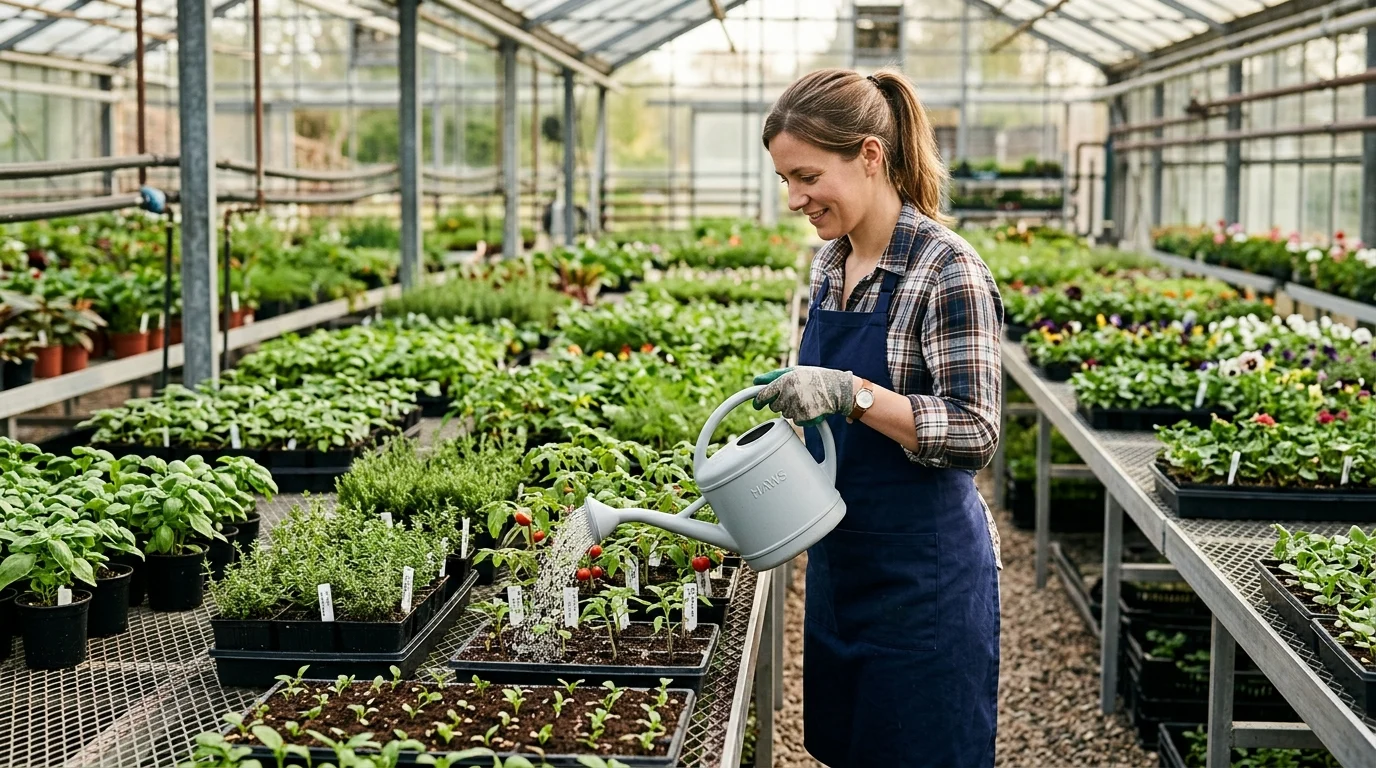
In a commercial nursery or greenhouse, watering is not just a routine task—it is a production variable that affects crop uniformity, labor hours, disease pressure, and water use. When crews irrigate thousands of trays multiple times per day, the wrong nozzle can compact media, expose roots, waste water, and create uneven growth across the bench. The right combination of fine Spray Nozzles, high-flow watering tools, splitters, and durable couplers helps deliver water quickly without damaging seedlings or sensitive blooms. This guide explains how purpose-built watering hardware improves coverage, protects root zones, and supports more efficient irrigation in high-density growing environments.
Why Nursery and Greenhouse Watering Needs a Purpose-Built Nozzle
Commercial nursery and greenhouse watering systems demand precise fluid dynamics that standard residential hardware cannot provide. In high-density cultivation environments, water must be delivered rapidly yet gently to maintain substrate integrity and plant health. Operators manage environmental variables at a massive scale, often requiring irrigation three to four times daily during peak summer production.
Commercial-grade wands and nozzles ensure water volume and velocity meet the rigorous demands of agricultural production without compromising the delicate root zones of young plants. The correct nozzle and coupler combination directly influences crop yield, minimizes water waste, and optimizes the daily labor required for manual irrigation.
Protecting Seedlings and Preventing Soil Displacement
The primary function of a specialized watering nozzle is to mitigate physical damage to young plants. When cultivating seedlings in high-density 288-cell or 512-cell plug trays, the kinetic energy of a standard hose stream can easily dislodge seeds, wash away lightweight peat or coir substrates, and expose fragile root systems.
Purpose-built nursery breaker nozzles feature hundreds of micro-holes to aerate the water and reduce droplet sizes to between 50 and 150 microns. This micro-fine output significantly lowers impact velocity, ensuring delicate foliage remains undamaged and soil compaction is minimized. Maintaining optimal oxygen porosity in the root zone is critical for early-stage development, and a specialized breaker nozzle guarantees the substrate absorbs moisture without physical displacement.
Improving Coverage Across Benches and Trays
Efficiency in a commercial greenhouse dictates that large areas be watered quickly and evenly. Purpose-built nozzles output high volumes, often ranging from 11 to 15 gallons per minute (GPM) at standard operating pressures of 40 to 60 PSI.
This high flow rate allows operators to swiftly sweep across 100-foot propagation benches, achieving a high coefficient of uniformity (CU) that typically exceeds 85%. Consistent, broad coverage prevents the formation of dry pockets that stunt localized growth and waterlogged areas that invite fungal pathogens like Pythium. By delivering a uniform sheet of water, commercial nozzles ensure an even crop canopy across thousands of individual trays, reducing the need for time-consuming spot watering.
Choosing the Right Nozzle and Splitter
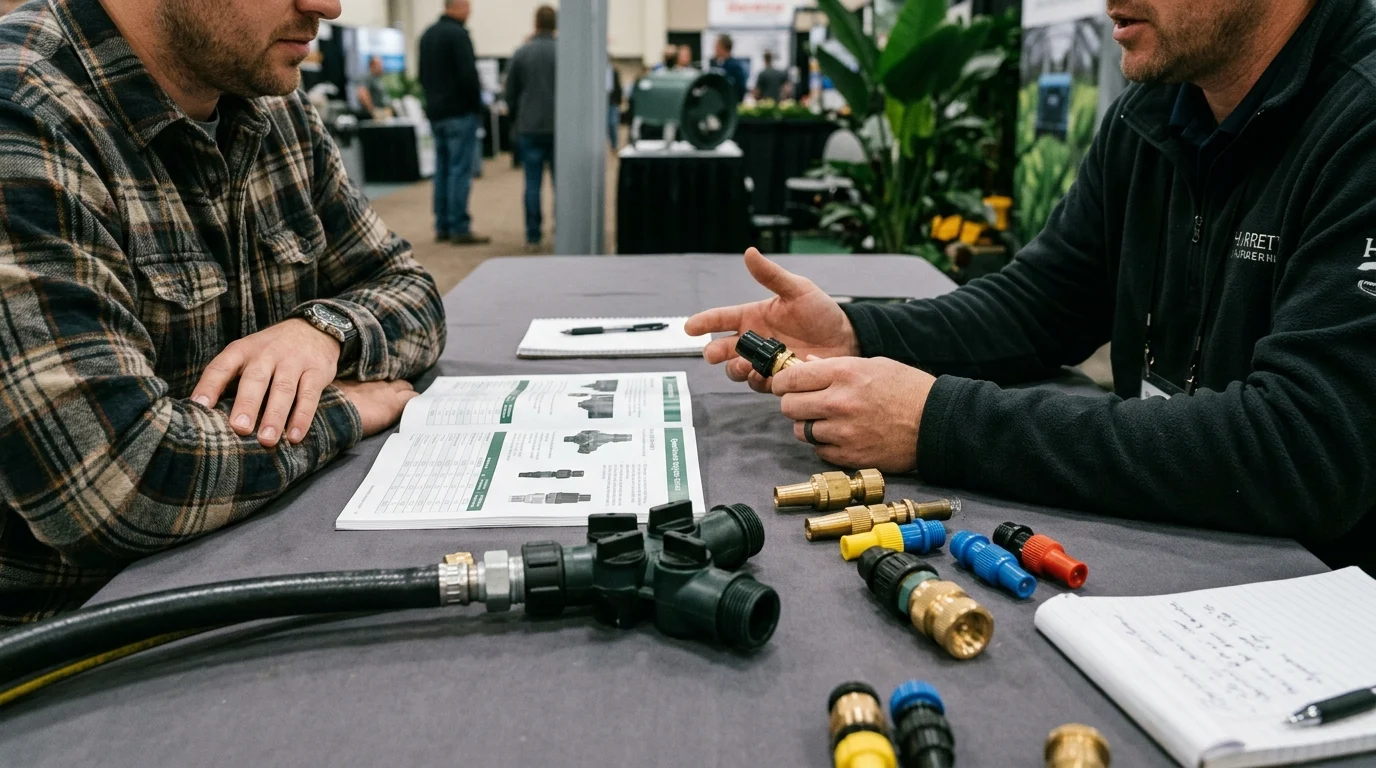
Selecting the correct hardware for a greenhouse irrigation manifold directly impacts water conservation and labor efficiency. Industrial watering tools must withstand continuous daily use, constant exposure to ultraviolet (UV) light, and the corrosive nature of liquid fertilizers.
Choosing the optimal combination of delivery nozzles and manifold splitters ensures the system maintains adequate pressure while offering the versatility required for different crop stages and operational zones.
Comparing Fine Spray and Multi-Pattern Nozzles
Different growth stages require distinct fluid delivery profiles. Fine spray nozzles, often constructed from machined aluminum or brass, deliver a high-volume, soft-impact shower ideal for propagation and sensitive blooms. Conversely, multi-pattern nozzles featuring adjustable turrets are utilized for broader maintenance tasks, such as washing down benches or filling mixing reservoirs.
| Feature | Fine Spray (Breaker) Nozzles | Multi-Pattern Adjustable Nozzles |
|---|---|---|
| Primary Material | Aluminum / Solid Brass | Heavy-duty ABS / Zinc Alloy |
| Optimal Droplet Size | 50 - 150 microns | 300 - 1000+ microns |
| Flow Rate (at 60 PSI) | 11 - 15 GPM | 3 - 8 GPM |
| Best Greenhouse Use | Seedlings, delicate plug trays | General washdown, mature shrubs |
| Impact Force | Very Low | Medium to High |
Operators must match the nozzle specification to the specific hydraulic requirements of the crop. Utilizing a low-GPM multi-pattern nozzle for a task requiring high-volume soaking unnecessarily extends labor hours, while using a high-GPM breaker on mature, hardy shrubs may result in excessive runoff and wasted water.
Using Four-Way High-Flow Ball Valve Splitters
To manage multiple irrigation zones from a single primary water source, four-way high-flow ball valve splitters are indispensable. These splitters allow a single 3/4-inch supply line to simultaneously feed independent hoses for hand-watering wands, overhead misting arrays, and automated drip manifolds.
Commercial-grade four-way splitters utilize full-port brass ball valves that prevent internal flow restriction. This design ensures a baseline pressure of 60 to 80 PSI is maintained across all open channels with less than a 5% pressure drop. The inclusion of thermoplastic elastomer (TPR) overmolded levers guarantees smooth operation even when valves are subjected to hard water scale or agricultural chemical buildup. This allows staff to isolate specific lines without shutting down the entire greenhouse manifold.
Building a Faster Commercial Watering Setup
Labor is consistently one of the highest operational expenses in commercial horticulture, often accounting for up to 30% of total overhead. Any bottleneck in daily maintenance routines, including the time spent configuring and moving irrigation equipment, directly reduces profitability.
By standardizing connections and upgrading to rapid-deployment hardware, facility managers can significantly streamline their commercial watering setups. This reduces physical strain on workers and maximizes the time spent on actual plant care.
Reducing Hose-Switching Time with Quick-Connect Couplers
Transitioning between different watering wands, fertilizer injector systems, and washdown sprayers via traditional threaded connections is highly inefficient. Manually threading a hose attachment takes an average of 30 to 45 seconds and carries a high risk of cross-threading or internal gasket displacement during rushed operations.
By implementing industrial quick-connect couplers, operators can swap end-tackle in under two seconds. In a large-scale nursery utilizing 50 or more hose bibs, this simple upgrade saves dozens of labor hours per week across the workforce. High-quality brass push-fit mechanisms are rated for burst pressures exceeding 200 PSI, guaranteeing leak-free performance and preventing catastrophic blowouts during overnight pressure spikes.
Key Buying Criteria for Nozzles, Couplers, and Splitters
When procuring commercial greenhouse watering equipment at scale, buyers must evaluate hardware based on lifecycle longevity and strict manufacturing tolerances. Prioritizing industrial-grade materials like solid brass, machined aluminum, and UV-resistant polymers ensures the chosen nozzles, couplers, and splitters will withstand the rigorous demands of daily agricultural production.
Key Takeaways
- Use purpose-built nursery breaker nozzles for seedlings and plug trays to prevent seed displacement, substrate washout, and root-zone damage.
- Select nozzles that can deliver roughly 11 to 15 GPM at 40 to 60 PSI for fast, even watering across long greenhouse benches.
- Choose fine spray nozzles for propagation and sensitive blooms, and reserve multi-pattern nozzles for cleanup, reservoir filling, and general maintenance.
- Aim for uniform coverage above 85% CU to reduce dry pockets, overwatered zones, and labor-intensive spot watering.
- Specify durable aluminum or brass watering components when equipment must withstand daily use, UV exposure, and fertilizer contact.
Frequently Asked Questions
Why should a greenhouse use a nursery breaker nozzle instead of a standard hose nozzle?
A nursery breaker nozzle softens and aerates the water stream, reducing impact on seedlings, plug trays, and lightweight substrates. Standard Hose Nozzles can dislodge seeds, compact media, and damage fragile roots.
What flow rate is typical for commercial greenhouse watering nozzles?
Many commercial nozzles deliver about 11 to 15 gallons per minute at 40 to 60 PSI, allowing crews to water long benches quickly while maintaining even coverage.
How do fine spray nozzles help protect young plants?
Fine spray or breaker nozzles use many small holes to create micro-fine droplets, often around 50 to 150 microns, which reduce velocity and help prevent soil displacement, foliar damage, and root exposure.
When should growers use multi-pattern nozzles?
Multi-pattern nozzles are best for general maintenance tasks such as rinsing benches, cleaning work areas, or filling reservoirs. For propagation and delicate crops, a dedicated fine spray nozzle is usually better.
Why does watering uniformity matter in nursery production?
Uniform watering prevents dry pockets that stunt growth and saturated areas that encourage fungal issues such as Pythium. Consistent coverage supports a more even crop canopy across trays and benches.