


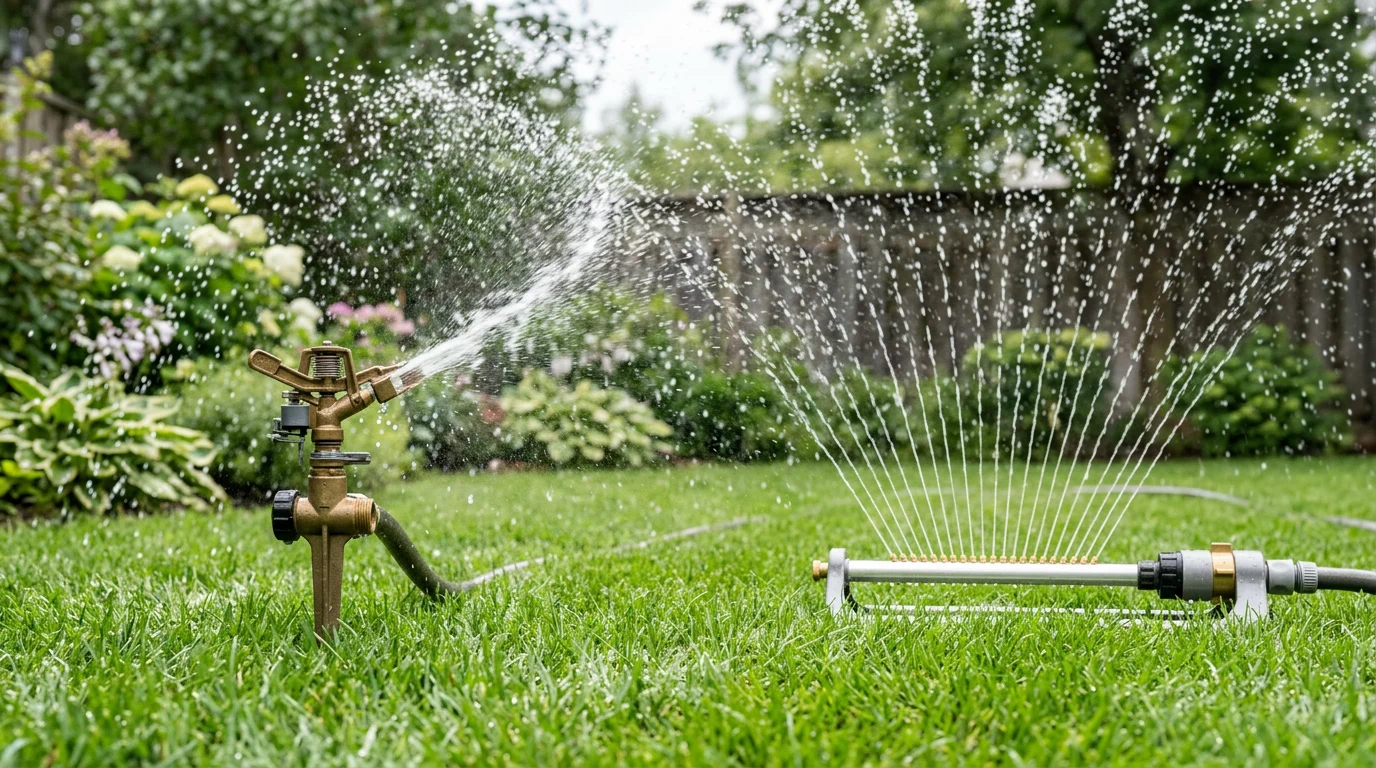
Watering a large yard efficiently is less about turning on the hose and more about matching the sprinkler to your lawn’s shape, soil, and absorption rate. Rotary sprinklers send streams in circular arcs and typically apply water slowly, making them useful for clay soils and sloped areas. Oscillating Sprinklers sweep a curtain of water across a rectangular area, often covering broad lawns quickly but with a higher risk of runoff or edge tapering. This guide compares how each type performs on coverage, precipitation rate, yard geometry, and soil conditions so you can choose the option that keeps grass healthy without wasting water.
Rotary vs Oscillating Sprinklers: Key Differences
Finding the best way to water a large lawn comes down to understanding the basic differences between rotary and oscillating sprinklers. Both systems deliver water at different rates and in different patterns. Homeowners should evaluate these options based on their specific grass type, soil composition, and local weather patterns to maximize water efficiency.
How each sprinkler type works
Rotary models use internal gear drives or impact mechanisms to rotate a nozzle, shooting single or multiple streams of water in a full circle or partial arc. Operating efficiently at standard residential pressures of 30 to 50 PSI, a gear-driven rotary sprinkler relies on water flow to turn a small internal turbine. The water pressure dictates the rotation speed and throw distance, making these models highly consistent. Conversely, an oscillating sprinkler operates via a water-driven cam mechanism. This moves a curved aluminum or plastic tube equipped with 15 to 20 precision nozzles back and forth, creating a sweeping, fan-shaped water curtain.
Coverage pattern and water distribution
The way water is distributed varies significantly between the two designs. Rotary sprinklers deliver water at a lower rate—typically 0.1 to 0.4 inches per hour—which allows heavy clay soils to absorb moisture without surface runoff. This makes rotary sprinklers ideal for sloped terrains where rapid watering could lead to erosion. While their spray radius can reach up to 40 feet per unit, achieving true large-yard coverage often requires overlapping multiple units. Oscillating models deliver a much higher precipitation rate, often exceeding 1.0 inch per hour at the center of the arc, with coverage areas extending up to 4,000 square feet. This rapid surface saturation is great for fast-draining soils or newly seeded lawns needing constant moisture. However, oscillating units are prone to edge-tapering, where the perimeter may receive up to 20% less water than the center, and their high output can easily cause runoff on compacted soils.
| Feature | Rotary Sprinklers | Oscillating Sprinklers |
|---|---|---|
| Mechanism | Gear-driven turbine or impact | Water-driven cam and tube |
| Precipitation Rate | 0.1 - 0.4 inches/hour | 0.5 - 1.0+ inches/hour |
| Max Coverage Area | Up to 5,000 sq. ft. | Up to 4,000 sq. ft. |
| Optimal Soil Match | Clay / Slow-draining | Loam / Sandy / Fast-draining |
Best Sprinkler Type for Different Lawn Shapes
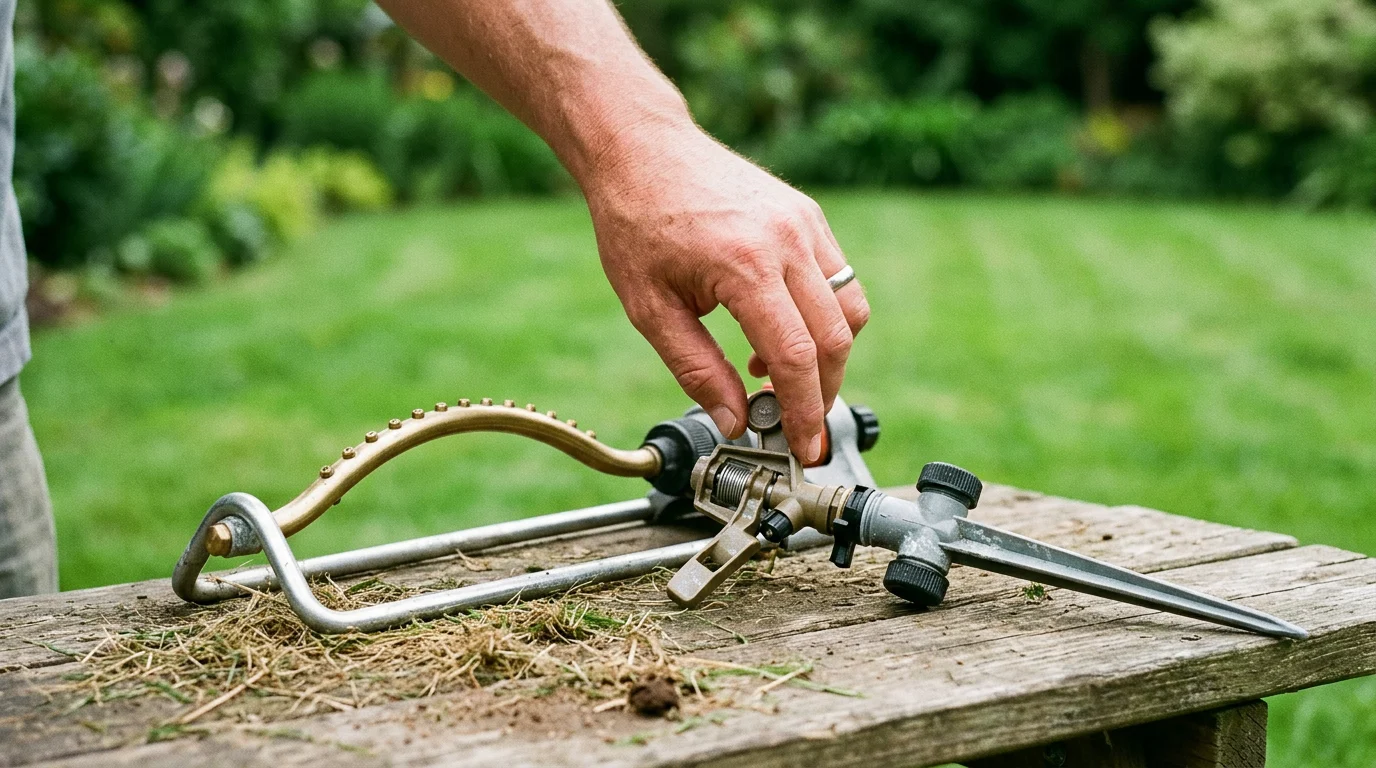
The shape of your yard plays a major role in choosing the right sprinkler. Matching the sprinkler's throw pattern to the yard's perimeter minimizes water wasted on driveways and ensures even coverage. Applying a circular spray pattern to a square yard inevitably leaves dry corners or flooded sidewalks, whereas using a rectangular pattern on a curved landscape wastes water.
Rectangular and square lawns
For properties with straight lines and right angles, the oscillating mechanism is usually the best choice. Using sprinklers designed for large rectangular lawns allows you to adjust the sweep, easily matching a 30-by-50-foot zone without spraying adjacent sidewalks. Advanced oscillating models feature width control switches, shutting off outer nozzles to narrow the spray pattern from 40 feet down to 20 feet. This helps achieve highly efficient coverage on grid-like plots, ensuring corners receive adequate moisture. Many models also incorporate a flow dial, allowing you to reduce the water output for smaller spaces like side yards.
Circular and irregular lawns
Landscapes featuring curved garden beds, circular fire pit zones, or asymmetrical boundaries benefit heavily from rotary units. Rotary sprinklers can be dialed to precise angles, such as 180 degrees for a semi-circular lawn edge or a full 360 degrees for an open, round field. The ability to adjust the throw distance—often from a minimum of 15 feet out to 45 feet—allows you to precisely trace irregular perimeters. Manufacturers estimate this rotational targeting can reduce water waste by 15% to 25% on non-linear plots compared to the rigid coverage of oscillating fans. By utilizing interchangeable nozzles, you can further customize the water output to match specific plant zones.
How to Choose the Right Lawn Sprinkler
Selecting the correct sprinkler extends beyond lawn geometry. Environmental variables, water pressure, and material quality must align to guarantee long-term performance and a healthy lawn.
Water pressure, wind, and soil conditions
Your home's water pressure directly impacts sprinkler performance. Oscillating units generally require a minimum pressure of 30 PSI to fully move the internal cam; dropping below this threshold can result in a stalled spray tube and localized flooding. Rotary sprinklers, particularly gear-driven variants, can operate effectively at lower pressures around 25 PSI but perform optimally at 45 PSI. Wind drift is another critical factor. Rotary models project heavier droplets at lower trajectories (typically 15 to 25 degrees), resisting wind deflection in moderate gusts. In contrast, oscillating units launch fine mists high into the air, making them highly susceptible to evaporation and drift at wind speeds exceeding 5 mph.
Durability, base type, and adjustability
A sprinkler's longevity depends heavily on its material composition and structural design. High-impact ABS plastics are treated to withstand UV degradation, often lasting for up to five years of seasonal use, while cast zinc or metal alloy bases offer superior stability to prevent the unit from flipping under high water pressure. Beyond durability, adjustability is key to fine-tuning your coverage. Look for models with intuitive dials and flow controls that allow you to adapt to changing yard conditions.
Ultimately, deciding which sprinkler provides better coverage for a large yard comes down to your lawn's shape and soil. If you have a sprawling, rectangular yard with fast-draining soil, an oscillating sprinkler will provide the broad, rapid coverage you need. However, if your large yard features irregular, curved boundaries, heavy clay soil, or frequent windy conditions, a rotary sprinkler—or a series of overlapping rotary units—is the superior choice for efficient, targeted watering.
Key Takeaways
- Choose rotary sprinklers for clay soils, slopes, or areas prone to runoff because their 0.1 to 0.4 inches-per-hour precipitation rate allows slower absorption.
- Use oscillating sprinklers on rectangular or square lawns where the back-and-forth spray pattern can cover straight edges more efficiently.
- Plan for overlap when using rotary sprinklers, even though some units can reach up to 40 feet or cover about 5,000 square feet.
- Avoid running oscillating sprinklers too long on compacted soil because their 0.5 to 1.0+ inches-per-hour output can cause pooling and wasted water.
- Match the sprinkler pattern to the lawn shape to reduce dry corners, overspray onto pavement, and uneven watering.
Frequently Asked Questions
Which sprinkler is better for a large rectangular lawn?
An oscillating sprinkler is usually better for rectangular or square lawns because its fan-shaped pattern matches straight edges and corners more efficiently than a circular spray.
Are rotary sprinklers better for clay soil?
Yes. Rotary sprinklers typically apply 0.1 to 0.4 inches of water per hour, giving slow-draining clay soil more time to absorb moisture and reducing runoff.
How much area can a rotary sprinkler cover?
A rotary sprinkler can reach up to about 5,000 square feet depending on water pressure, nozzle design, and spacing, but large yards often need overlapping units for even coverage.
Do oscillating sprinklers waste more water?
They can if used on compacted soil, slopes, or windy days. Their higher output can exceed 1 inch per hour, which may cause runoff or uneven edge coverage.
What water pressure works best for rotary sprinklers?
Most gear-driven rotary sprinklers perform well at standard residential water pressure, typically around 30 to 50 PSI, which supports steady rotation and consistent throw distance.